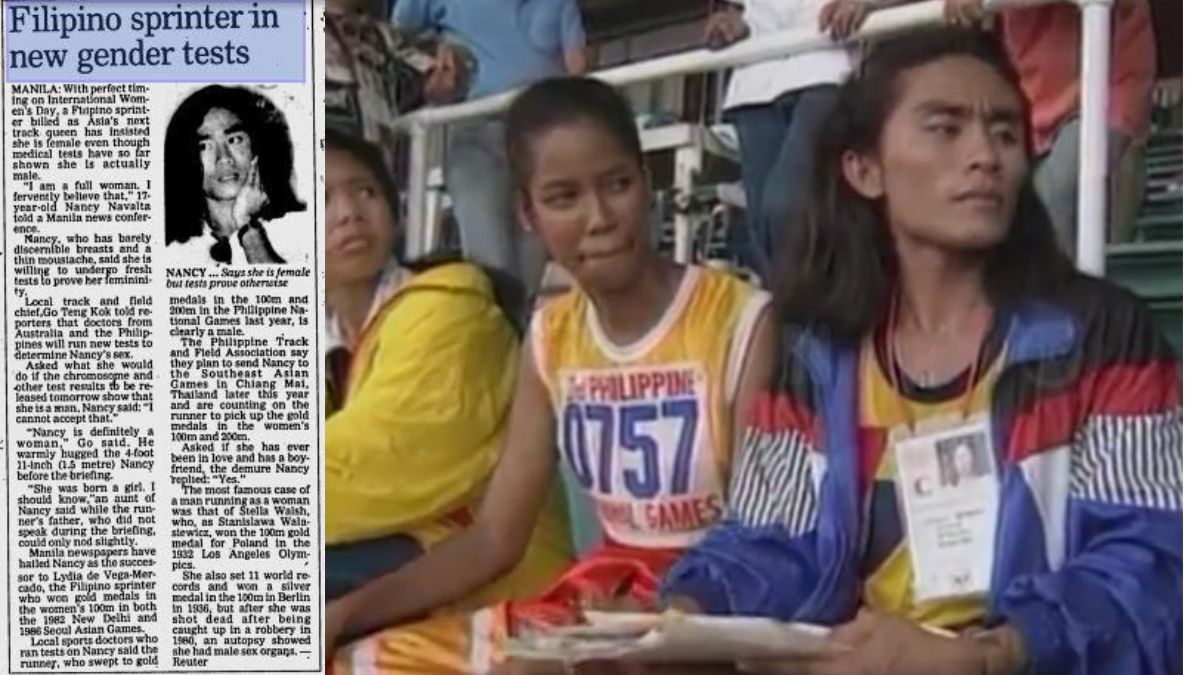
CONTROVERSY continued to shadow Algerian boxer Imane Khelif after beating Hungary’s Anna Luca Hamori in a quarterfinal bout that assured her of at least a bronze medal in the Paris Olympic Games.
Khelif won by unanimous decision in their 66-kg division. She had earlier beaten Italy’s Angela Carini who had abandoned their match after getting punched in the nose 46 seconds after the bout started.
Carini said she had never been hit so hard in a bout.
READ IOC laments 'abuse' on boxers Imane Khelif, Lin Yu-ting
Khelif, born female, found herself in a firestorm of criticism and protests surfaced about her gender. The International Olympic Committee came to her defense.
"Let's be clear here: We are talking about women's boxing," said IOC president Thomas Bach on Saturday, "We have two boxers who are born as a woman, who have been raised as a woman, who have a passport as woman, and who have competed for many years as women. And this is the clear definition of a woman. There was never any doubt about them being a woman."
She and Chinese Taipei’s Lin Yu-ting, both of whom have previously failed gender eligibility testS administered by the International Boxing Association (IBA). Many said the protests were political because the IOC stripped IBA of its status as the sport’s governing body last year and the IBA is now leading the protest.

The controversy reminded us of a similar situation involving local sprinter Nancy Navalta.
The runner, who came from an impoverished family in Pangasinan, was assigned female at birth. Then as she grew up, she became interested in sports and turned out to be good enough to compete in the Palarong Pambansa in 1991 in Iloilo.
It wasn’t until she excelled the following years that questions about her gender arose. It became intense after she won the women’s 100m and 200m events in the Palarong Pambansa held in Isabela.
'Flat chest, wispy mustache'
The chatter continued the following year, especially after Navalta won six more golds. They targetted her physical attributes saying she has a “flat chest, muscled physique, and wispy mustache.”
Rumors followed her during the Private Schools Athletic Association (PRISAA) event in her province. She competed in the women’s event but a week later, apparently feeling too good for women runners, she reportedly competed in the men’s category, placing fourth in the 100m dash.
She explained to a Palawan News a report in 2019: “Sabi nila lalaki si Nancy, nakilaban sa lalaki. Hindi nila alam na ang mga batang tinuturuan ko tsina-challenge ko lang sila na habulin nila ako.”
Navalta was poised to represent the country in Atlanta 1996 after registering a time of 11.42 seconds, earning a qualification in the women’s 100m event. She would have been the third member of the athletics contingent in the Philippine delegation together with marathoner Roy Vence and long jumper Elma Muros.
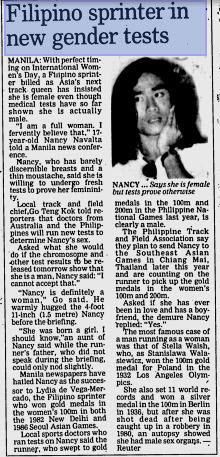
Navalta also recalled clocking 10.08 during one of her training sessions in Baguio. Compare that to the time of United States’ Gail Devers, who the gold in the Atlanta Olympics in 10.94 in the 100m. Perhaps we could have had an Olympic winner as early 1996.
But before the team departed, Navalta was asked to undergo a sex test upon the recommendation of then- Philippine Center for Sports Medicine head Tyrone Reyes. There, she was ruled to be an intersex and was barred from competing.
(The intersex definition is a person born with a combination of male and female biological traits).
“Mas malakas ang male hormones ko. Binasehan nila ang physical features,” she was quoted in the same report.
Upon receiving the report, Navalta walked away from the sport, ending a fleeting career and abandoning her Olympic dreams. The athlete, who was billed as "the next Lydia de Vega," was no more.
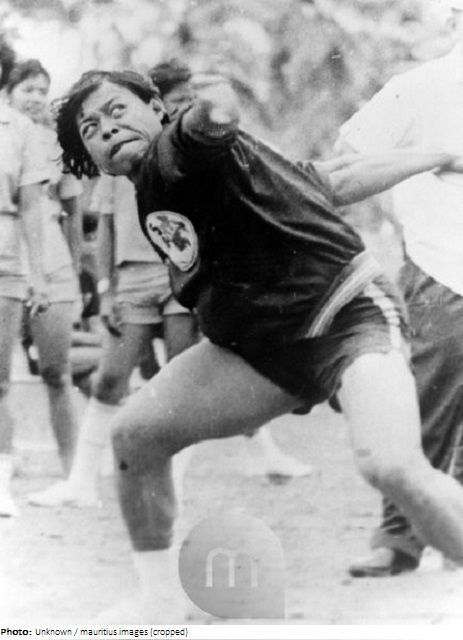
Actually, Navalta wasn't the only Filipina athlete embroiled in such controversy.
Mona Sulaiman, once hailed as Asia's fastest woman, is also another athlete whose gender was put in doubt after her superb performances on the track back in the sixties.
Sulaiman was able to represent the country in both the 1960 Rome Olympics and in Tokyo 1964. In between she won three gold medals in the 1962 Asian Games in the 100m and 200m as well as the 4x100m relay.
But when gender tests were introduced later in the decade, she expressed apprehensions on the procedure and declined to undergo the procedure before eventually pulling out of the 1966 Bangkok Asian Games.
She was subsequently banned from athletics.

Like Sulaiman who resurfaced in the 1990s to serve as a consultant at the Philippine Sports Commission, you can't take the sport away from Navalta. She is now serving as track and field coach to aspiring runners in Vigan.
Under the current IOC rules, would she have been allowed to compete?
Probably, because gender tests have been deemed abusive and have been disallowed by the IOC.
Get more of the latest sports news & updates on SPIN.ph
NOTICE ON UNAUTHORIZED AND UNLAWFUL USE, PUBLICATION, AND/OR DISSEMINATION OF SPIN.PH CONTENT: Please be notified that any unauthorized and unlawful use, publication, and/or dissemination of Spin.ph’s content and/or materials is a direct violation of its legal and exclusive rights to the same, and shall be subject to appropriate legal action/s.
