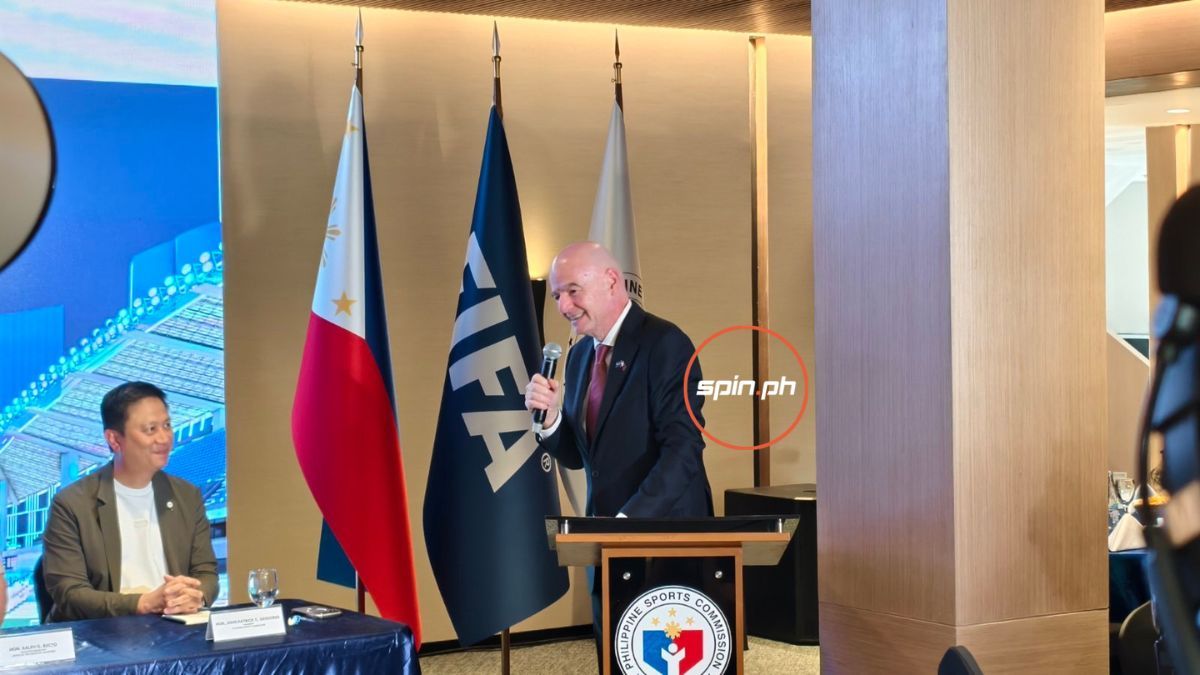

FIFA president Giannni Infantino blew into town a few days ago and promptly captivated local sports officials, not just with the charm which he has, many concede, in considerable amounts, but with what he brought: A $20-million donation to the Philippine Football Federation.
The staggering amount—1.5 billion in Philippine currency at current rates—is to be used to remodel the ancient Rizal Memorial Football Stadium built in 1934 and transform it into a world-class facility with seating for 25,000 spectators.
Part of the money is also to be spent in building three football centers: one in Bacolod, another in Cagayan de Oro, and one in a still unspecified city of Luzon. The objective: to bring more youth into the game. And, it is hoped, to ignite a grassroots football revolution that will bring the country at par with its more progressive neighbors in a sport widely conceded as the most popular in the world.
READ: FIFA chief arrives to donate $20M for Rizal Stadium redevelopment
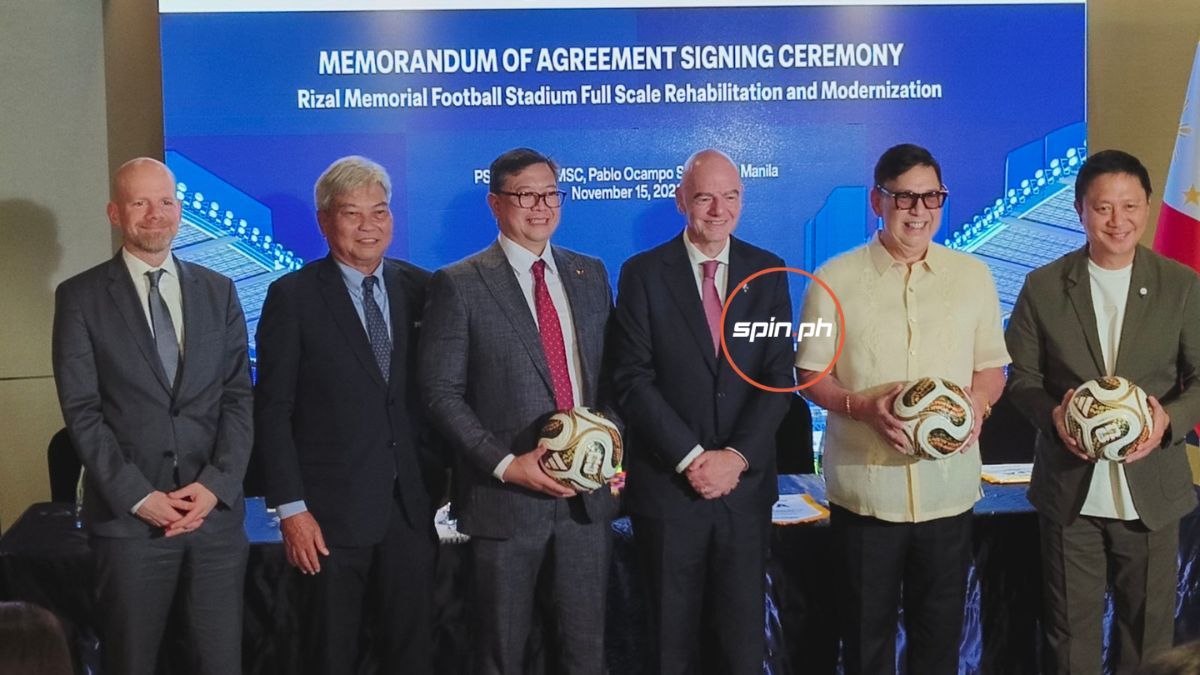
A signing ceremony was held Sunday, featuring Infantino, PFF president John Anthony Gutierrez and Philippine Sports Commission chairman Patrick Gregorio.
The FIFA-PFF plan falls within the same platform championed by Gregorio, who has, since his chairmanship in July 2025, moved around the country building sports facilities with a frenzy unseen in any of his predecessors.
With the $20 million, the planned modernization of local football stadiums will spare public money. The money this time will totally be from FIFA, whose coffers, already one of the most robust among international sports federations, ballooned significantly following the success of the just-concluded World Cup.
That Infantino has come around to hand over $20 million personally is probably not without a caveat.
The man is, after all, running for a fourth term as FIFA president in elections set for March 18, 2027. He has been FIFA president since 2016, replacing Sepp Blatter. He was reelected in 2019 and 2023.
Although he is here as the main guest of the Asean Football Federation Congress, his presence can also mean he wants to hobnob with Asean football’s top brass whose votes he needs—every football association president casts one vote—as he fights a leadership challenge posed by a minority, albeit a powerful and influential block, from Europe.
In a contest where every vote counts, perhaps Infantino wants to ensure that Philippine support, as well as that of other Asean countries, is firmly locked in his favor.
In any case, he will have no problem with PFF’s Gutierrez. The man was quick to declare his support for the Italian’s presidential bid at about the same time a substantial number of the 211-member FIFA began expressing doubts about Infantino’s leadership.
You have to give it to Infantino. He rose from the ranks and became the head of the richest and most powerful sport organization on the planet that owns the biggest and most popular event: the World Cup.
He knows how to massage relationships and is clearly willing to go to great lengths—take his trip to the Philippines today—to get what he covets.
He also obviously knows how to use FIFA’s biggest asset, its billions in earnings and savings, to get members believing that their own future success lies in aligning their interests with Infantino’s.
Shortly after the World Cup concluded, FIFA reported revenues of $15 billion, after which Infantino swiftly announced that $10 billion would go to global football development and member-association reinvestment.
That has translated to the $20-million endowments to each of the 211 members of FIFA, including the Philippines, whose allotment Infantino himself announced during his visit here.
The money is not a direct donation from Infantino, although it could appear that way in PFF’s media releases.
The money comes from FIFA’s general fund. And, as has been said, it is not only the Philippines that shall receive $20 million, it is every member of FIFA , rich and poor alike.
That the money is being distributed worldwide just as FIFA prepares for its coming election makes one wonder whether there is a connection between his reelection campaign and the timing of his Philippine visit.
The man has been under attack for, among others, unilaterally giving U.S. President Donald Trump a Peace Prize, overturning the one-game suspension of U.S. player Falorin Balogun during the World Cup after a phone call from Trump, and, most damning, attempting to sell World Cup rights to a hedge fund without consulting other FIFA officials.
As a result of this, many federations revolted against his leadership. What initially appeared as Infantino running unopposed has now turned into a contested election.
There are currently three people who have declared their intent to challenge Infantino. The latest is French Football president Philippe Diallo who is supported by Europe’s governing body, the UEFA.
Also in the race for the top FIFA post are Ramon Vega, a former Tottenham Hotspur defender, and Japan Football Association president Kozo Tashima.
But whatever the motive in dispensing the enormous amount—especially to countries that badly need the funds, like those in Asia and Africa—the important thing at the moment is that Philippine football just got a monstrous boost to improve its facilities and to grow the game.
And whether or not Gutierrez’s vote for Infantino has been influenced by the largesse, only he can say.
In any case, the country’s other sports officials are probably wiser than the rest of us. They always follow where the money is.
Get more of the latest sports news & updates on SPIN.ph
NOTICE ON UNAUTHORIZED AND UNLAWFUL USE, PUBLICATION, AND/OR DISSEMINATION OF SPIN.PH CONTENT: Please be notified that any unauthorized and unlawful use, publication, and/or dissemination of Spin.ph’s content and/or materials is a direct violation of its legal and exclusive rights to the same, and shall be subject to appropriate legal action/s.

