IT is quite ironic that a sport that has been played in the Philippines for the last hundred years is still largely unknown to Filipinos.
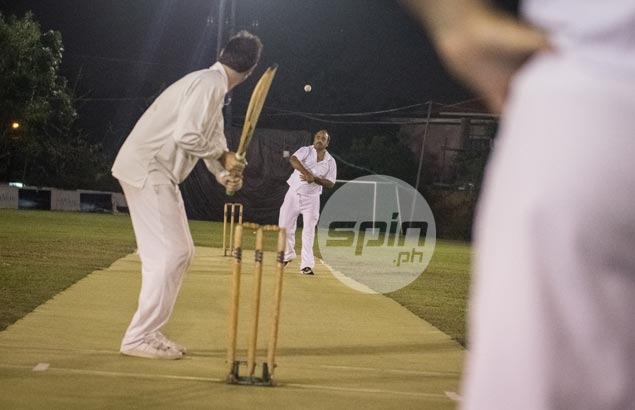
Despite this, cricket continues to thrive and has actually quietly grown, a fact that sinks in as you watch a Philippines Cricket League match between the Manila Cricket Club and RK on a Friday night inside the Merville Subdivision in Paranaque City.
The Manila Nomads Sports Club is a sanctuary for Philippine-based fans of this 'Gentleman's Game,' considered a religion by billions of its diehard fans who find themselves in the Pearl of the Orient.
The sports club, located at the edge of the Ninoy Aquino International Airport (made plain by the scores of aircraft constantly taking off in plain sight of the field), is presently the lone venue for a league that has 17 clubs competing in two divisions.
Faisal Khan, the erstwhile captain of the first Philippine national cricket team, said they are now looking for a new location to host their games since the other field they were using in Pasay City was turned into a night market during the holidays.
Khan explained the participating clubs are composed of 11 players each and mostly based in Metro Manila except for three from Laguna, Bulacan and Baguio City. Clubs play one match every Friday and four every Sunday.
Curiously, not one player in these teams has a player born of Filipino parents, a fact Khan confirmed and is part in trying to address.
Currently, members of these teams are composed of expatriates and foreigners from India, Pakistan, Sri Lanka, Australia and New Zealand, countries that used to be part of the British Empire where cricket is considered the national sport, especially in India.
Watching a match bears this out - all of the players are either Southwest Asians or Caucasians.
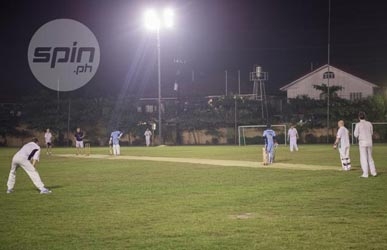
Encouragements, taunts, the unique “Howzat?” appeals and instructions were shouted in heavily accented English, Hindi or Urdu from the participants on and off the lighted field. Game officials included an Australian and a Pakistani. The only Filipino in direct involvement in the game was the scorekeeper.
Conversation at the open bar was dominated by players in white slacks using the King’s English over pints of Guinness with the telly (or TV as we call it) tuned to a Premier League match. With the cold weather, it didn’t take much effort to imagine you were in another place on that particular Friday evening - a hill station in northern India or a chilly spring evening in Sussex perhaps?
The action, of course, is intense in the nearby Nomads field, where two teams of 11 players each battle it out in what usually is a football and rugby court, except that a rectangular 22-yard long pitch was placed in the middle. Each team takes its turn to bat, attempting to score runs, while the other team fields.
The batting team continues batting until 10 batsmen are out, at which point the teams switch roles and the fielding team comes in to bat and tries to outscore the first team. The game ends after the second team tallies a higher score than their opponents or have 10 batsmen out.
At first glance, many Pinoys associate cricket with baseball, which is no surprise since the American pastime is actually an offshoot of cricket (according to Khan, the Americans resorted to changing the rules since they did not want to be playing a sport identified with the British at the time).
In the country, the Philippines Cricket Association is the official organization sanctioned by the International Cricket Council, the international governing body of cricket, to oversee the sport. The PCA, in turn, organizes the Philippine Cricket League as its main event of every year.
There are also lesser tournaments that include Sixes Tournaments, where the number of players is reduced to six from the original 11 in order for more teams to be able to take part.
“We have two every year - one is international where we invite international teams to come here and compete with the local teams and the other one is domestic sixes tournament where the same 17 teams compete. It’s a shorter format of the game. Other than that, we have social games which are one-off games,” Khan said.
As a sign of cricket’s growth in the Philippines, last year’s international tournament that was held in Clarkfield, Pampanga was sponsored by telecommunications company Globe.
“Globe recently decided to lend their hand in Philippine cricket and we are really thankful to them for sponsoring our events. Globe has taken a lead and they now want to take it to the next level, before it was more of a social thing, now its more regular and more formalized,” Khan said.
The three-day event saw twelve teams competing in the tournament, including clubs from Singapore and Hong Kong. There were players from Britain, Australians, Indians and Pakistanis.
“It’s a very close-knit community. We all know each other personally. We welcome newcomers. Usually we can judge in the field a person’s attitude while playing with us,” he said.
As part of the PCA’s plans, Khan said they are presently training an all-Filipino team that will be capable of playing at a competitive level. The selection will be composed of eight local players with three members from the national team.
If things fall into place, hopefully Juan dela Cruz will soon join the ranks of the Roos, Punjab, Desh Mesh and the Pak Tigers playing on the “green grass of home."
Get more of the latest sports news & updates on SPIN.ph
NOTICE ON UNAUTHORIZED AND UNLAWFUL USE, PUBLICATION, AND/OR DISSEMINATION OF SPIN.PH CONTENT: Please be notified that any unauthorized and unlawful use, publication, and/or dissemination of Spin.ph’s content and/or materials is a direct violation of its legal and exclusive rights to the same, and shall be subject to appropriate legal action/s.
