
IT’S never too early for Gilas Pilipinas to prepare for the 2023 Fiba World Cup. After all, it’s one the country is co-hosting. Therefore the national team should put its best foot forward in front of the home crowd.
And one aspect the national team must be burning the midnight oil on is its shooting, if it wants to redeem itself from a disastrous 2019 edition - and exceed its performance in 2014 when it returned to the world stage after a four-decade absence.
Analytics coach Paolo Layug made a deep dive into the importance of shooting, particularly from beyond the arc, in an assessment on his blog last month.
While size won’t be much of a problem with Kai Sotto, AJ Edu, and Co. among those expected to be at its disposal by 2023, Gilas can bank on a more-reliable three-point shot to at least give opponents different looks.
“We need to complement that size with better shooting,” Layug said in his blog entry entitled, “SONA: 3PT Shooting in the Philippines” where he compiled three-point shooting stats obtained from ABS-CBN Sports’ Norman Riego, Humblebola, and UAAP and PBA statisticians Pong Ducanes and Fidel Mangonon III.
“I’m a big believer that shooting will have to be one of our main weapons if we want to win a couple of games and advance to the next round in the 2023 World Cup,” added Layug, a former Alaska analytics coach and video coordinator.
Filipino cagers, at least, have embraced the basketball evolution and joined the three-point revolution – the “Steph Curry effect” as Layug noted. Comparing the shot profile of the PBA with other top Asian pro leagues in the last seven seasons, Layug confirmed the idea that the increase in three-point shooting volume is as rampant as COVID-19.
Plotting it in a line graph, the PBA, like every other Asian league, has taken more three-point attempts in the last seven years – from 27.7 percent in 2014 to a little over 35% of their total field-goal attempts this year.
The problem, however, is accuracy. Three-point field-goal shooting percentage has seen a steady decline in the last three years. After putting up a solid 33.3% as a whole in the 2016-17 season, the PBA numbers have gone down to 31.9% last season – the lowest among Asian leagues Australian NBL, CBA, and KBL.
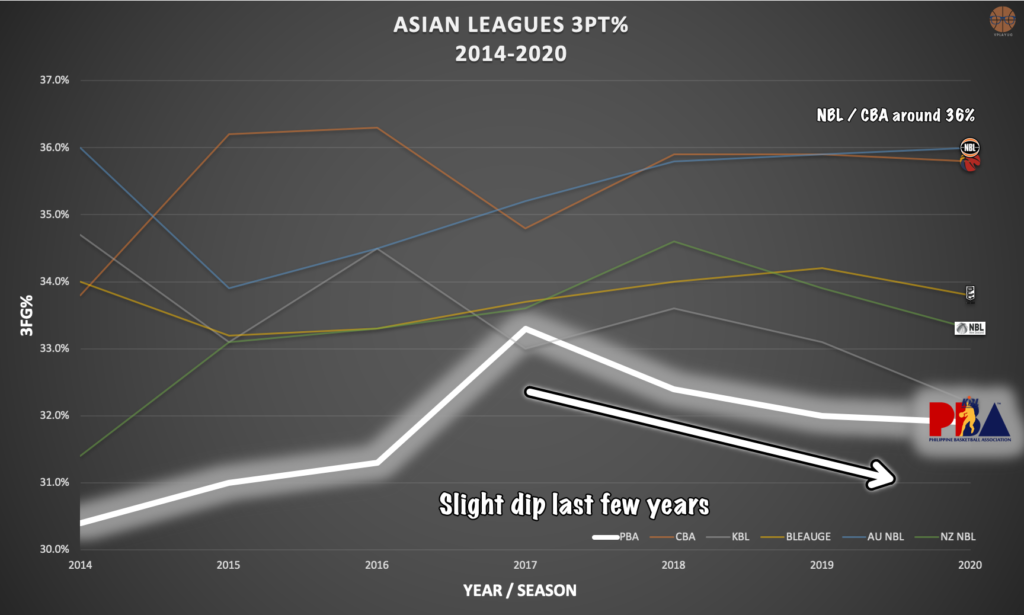
Layug highlighted the high volume and poor percentage in the last World Cup where Gilas was sixth in three-point attempts, but converted just 25.2% of its treys to wound up second to last among 32 countries, ahead of only Puerto Rico. Layug also listed the individual percentages of every PH team shooter, with Robert Bolick (38.9%) and C-Jay Perez (33.3%) emerging as our top snipers.
Layug, now a St. Benilde assistant coach who’s also part of Charles Tiu’s staff at Mighty Sports and Nueva Ecija in the MPBL, did note that Spain won the World Cup despite ranking just 19th in the tournament in three-point shooting at 31.7%.
Still, it’s not a reason to be complacent.
And early preparation starts earlier than in the pro level.
“Like all other coaches, I don’t think getting better at shooting is simply going to happen overnight – it’s going to take time,” Layug said. “Moreover, I think the improvement in our shooting numbers will have to begin at the younger levels, especially in the collegiate and HS levels.”
Layug then charted the three-point shooting percentages in the college and high school ranks, finding out that the NCAA (30%) is shooting better from long range than the UAAP (28.2%) in the seniors’ division last year.
The NCAA is also shooting better than the UAAP in the juniors’ division, draining 26.9% of its shots as a league compared to just 24.5% by the UAAP last season. What’s alarming is that the UAAP fell from a high of 27.6% shooting in the 2017 season, while the NCAA has been hovering around the 26% mark for the last three years.
With plenty of room for improvement, coming out of this pandemic can help players, especially high school cagers, “rebuild” their shots and develop better habits, Layug noted.
And nothing beats hard work and repetition.
Layug presented Gilas mainstays and TNT stars Troy Rosario and Roger Pogoy as two of the best examples of former high school non-shooters who have worked hard into becoming true snipers in the pro ranks.
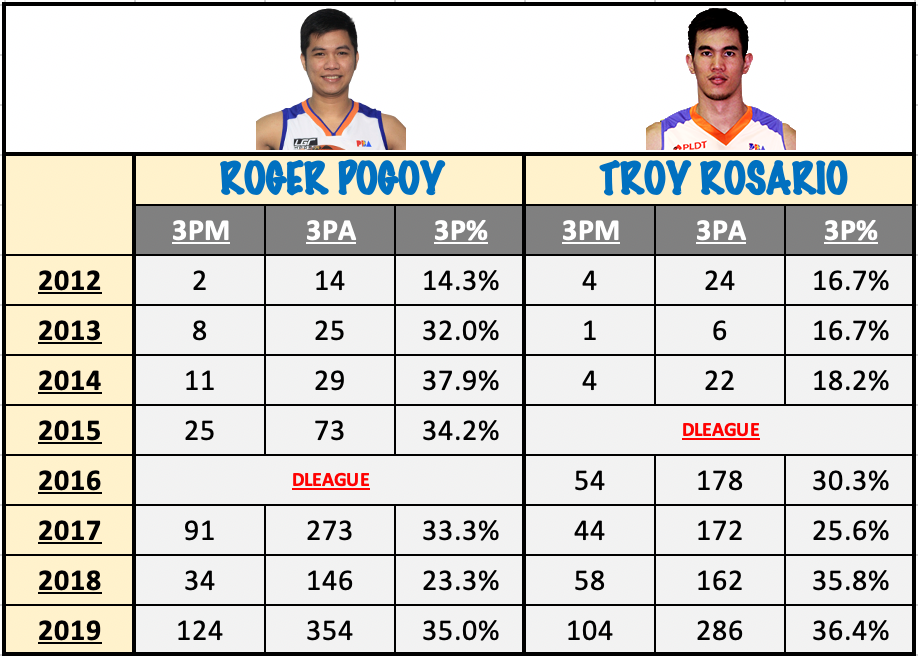
A power forward at University of Cebu in high school, Pogoy turned into a wingman at Far Eastern University in college, while Rosario was a traditional big man at National University before becoming a stretch big in the PBA.
Layug laid out their dramatic improvement: Pogoy, after putting up just 14 attempts and shooting 14.3% in 2012, has fired 354 attempts and buried 35% of his triples in 2019, while Rosario, with just 24 attempts and 16.7% in 2012, has increased his volume to 286 shots and improved to 36.4% from long distance last year. Both, though, couldn't translate that shooting to the World Cup as Pogoy shot just 25%, while Rosario hit only 10% of his treys.
Rosario said the conscious effort to become a better shooter came from the need to look for other offensive weapons when the Cagayan Valley native was still too lanky to withstand the banging in the paint.
“Nung una kasi ‘di pa ganito katawan ko so ‘di ganun kalakas sa banggaan, kaya nag-isip ako ng paraan para maging effective. So triny ko improve shooting ko mahirap sa umpisa kasi kailangan mo patunayan na kaya mo umiskor sa beyond the arc,” Rosario said.
The prototype 6-foot-7 stretch forward added he hasn’t made a change in his form until recently when TNT active consultant Mark Dickel noticed something about his foot positioning.
“Sobrang wide kaya minsan matulis ang tira ko, so inuunti-unti namin in-adjust,” Rosario said. “I can say better na ngayon pero may konti pa na ia-adjust.”
As a coach, Layug pondered on ways to improve players' shooting – from devoting more shooting training in practice to the type of shooting drills between block (shooting from one spot) and variable (mixing the spots).
Layug offered a simpler way he can help: being a shooting partner and spoiling his shooters.
Come game time, players will have the abundance of confidence.
“Confidence siguro,” Rosario said when asked about the secret to his shooting. “Sa team namin, I’m one of the guys na tasked to take shots from beyond the arc. Given that go-signal taas na kumpiyansa ko tapos I take a lot of shots pa sa practice. So alam ko pag sa game pag may opportunity at open and galing sa magandang execution, wala ng isip-isip – let it fly.”
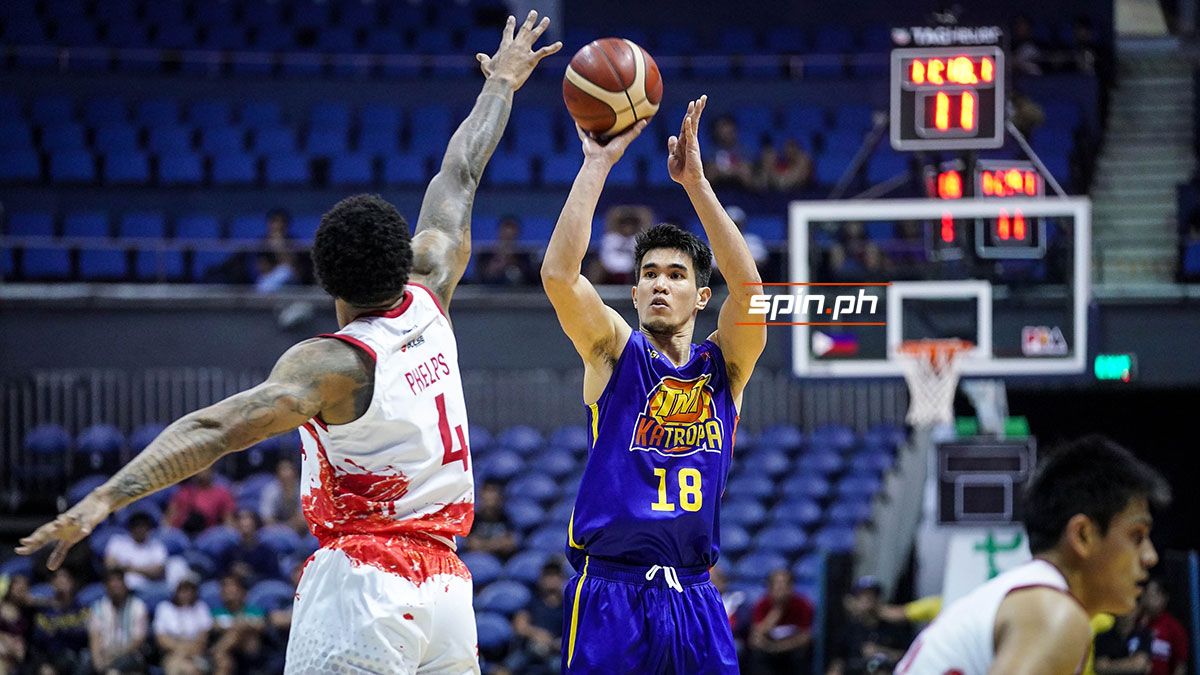
Layug noted that one reason why three-point shooting is dropping is because more bigs are shooting treys - but that's a small concern.
“Nag-aadjust pa sila,” Layug said in a text message to SPIN.ph. “So I think once they get used to it more and more, tapos college bigs are shooting more 3s rin. It’ll increase over time.”
Layug added that he put up his blog entry not to criticize, but to “help us get better.”
“The only reason I went through the trouble of going through all these stats to show our shooting percentages is that I want to raise awareness on it. Yes, our high school and college players are slowly improving, but will it be enough? After all, our FIBA Asia counterparts are also hard at work,” Layug said.
“We should aim to be the best shooters in our region and the only way we get there is from the ground up. We need to raise the floor. That part is on us coaches.”
Spin fans unite at the Spin Viber Community! Join the growing community now and complete the experience by subscribing to the Spin Chatbot.
Get more of the latest sports news & updates on SPIN.ph
NOTICE ON UNAUTHORIZED AND UNLAWFUL USE, PUBLICATION, AND/OR DISSEMINATION OF SPIN.PH CONTENT: Please be notified that any unauthorized and unlawful use, publication, and/or dissemination of Spin.ph’s content and/or materials is a direct violation of its legal and exclusive rights to the same, and shall be subject to appropriate legal action/s.
